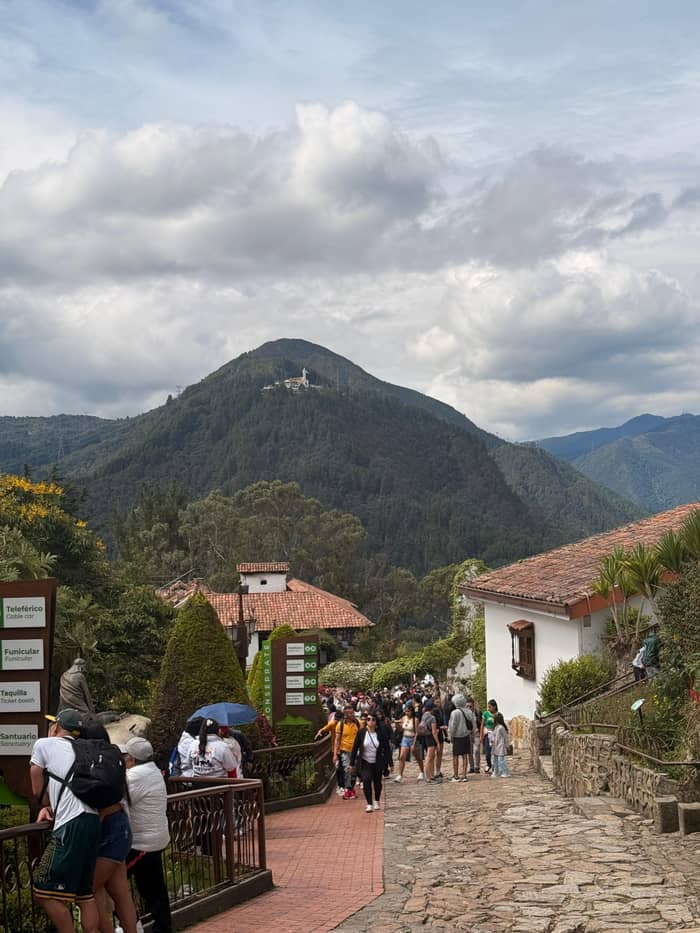
Focus of devotion
The Fallen Lord
Carved wooden figure
- Carved byPedro de Lugo Albarracin18
- MaterialsWood with lead and silver18
- Date1656 on the sanctuary site4
Guides
Language
Currency
View availabilityfrom $70 · cancel for freeTick-off checklist
Things to do · 10 items
Mark each item when done. Progress is stored on this device.
0 / 10 ready
Ready to go. Only your date and your pickup point are left to choose.
Book your placeHow a hilltop chapel became the pilgrimage church above the city: the carved Fallen Lord, the Virgin of Montserrat, the Stations of the Cross, the week of services and the visit you can plan.
Editorial team, monserratetour.top · Updated November 23, 2026 · Quick read: 8 min
Essentials
The story of the Monserrate sanctuary starts with the city itself. The sanctuary's own history page counts the hill, along with Guadalupe, among the mountains meant to watch over the young city of Santa Fe de Bogota, founded by Gonzalo Jimenez de Quesada in 1538.10 ProColombia adds that the Muisca called the mountain Cerro de Las Nieves because of the frequent cloudiness, a name that still suits the mornings when cloud sits on the ridge.11
The religious story begins with a small chapel. In 1640, according to the sanctuary, Pedro Solis de Valenzuela and other devotees built a small chapel on the summit in honor of the Virgin of Montserrat, and that chapel began Monserrate as a place of pilgrimage.3 Official pages differ on some early dates, and this guide gives each date by its source: Visit Bogota dates the first hermitage to 1657, and ProColombia gives 1640 for the carved image.12,13
The sanctuary's timeline then turns to the figure that gave the hill its devotion. In 1656 the priest Bernardino de Rojas commissioned Pedro Lugo de Albarracin to carve a fallen Christ, and the image became the focus of worship, especially after the miracles attributed to it.4 The sanctuary adds that the chapel withstood the earthquakes of 1743 and 1745 that devastated much of Bogota, which heightened the veneration of the Fallen Lord.14
On the summit
| Place | What it holds | Worth knowing |
|---|---|---|
| Basilica | The carved Fallen Lord and a replica of the Virgin of Montserrat20 | Opens early on most days and from noon on Tuesday8 |
| Stations of the Cross | Images of the Passion brought over from Italy2 | Relived on foot, by cable car or by funicular in Holy Week9 |
| Gardens | Floral arrangements and the Pozo de los Deseos wishing well27 | Visitors toss a coin and make a wish27 |
| Summit square | Handicrafts and souvenirs, with restaurants beside it28 | Dishes such as ajiaco and caldo de costilla28 |
| Coin machine | A coin engraved with an image of the Sanctuary29 | A keepsake of the visit29 |
Details come from the sanctuary site, ProColombia and Visit Bogota, and where their dates differ the page names the source.29
The sanctuary is defined by its images. Visit Bogota describes the Fallen Lord as a wooden figure that includes some lead and silver, made by the master Pedro de Lugo Albarracin.18 ProColombia says the figure shows Jesus at the third of his falls on the road to Calvary.19 The pose is part of why the pilgrimage feels less like sightseeing and more like a walk beside someone who has fallen and gets up again.
The second image gives the hill its name, the Virgin of Monserrate in Bogota. Visit Bogota says the sanctuary holds a replica identical to the Virgin of Montserrat kept in the Monastery of Montserrat in Barcelona, Spain.20 That link explains the spelling that confuses travelers: the hill is Monserrate in Spanish usage in Bogota, while the monastery in Barcelona that inspired the devotion is Montserrat, and the hill and the monastery are different places with a shared story.
Belief gathers around the Fallen Lord. ProColombia says that, according to believers, the statue is miraculous, that its hair grows and that its weight increases when people try to bring it down to the city.21 Devotees make offerings of their own, and Visit Bogota lists climbing on their knees, ascending the hill blindfolded or keeping other promises in exchange for favors.22 A respectful visitor can read these as traditions of faith without needing to judge them.
The Fallen Lord has left the hill on special occasions. The sanctuary's history page records that the image first came down to Bogota in 1916, when the city prayed for relief from a severe drought, and again in 1952 to ask for peace.35,36 Each descent was an event for the whole city, and the image went back up afterward, so the hill stayed the home of the devotion.
The most recent descent is dated on the sanctuary site to November 21, 1998, when the image returned to the capital to pray for peace in the country.37 Those dates show how the sanctuary has served as more than a church for the city: it has been a place people turned to in a drought and in years of conflict, and the hill still carries that role in its pilgrimage calendar.
The calendar peaks in Holy Week. The sanctuary says thousands of pilgrims gather on Good Friday to offer their prayers to the Fallen Lord, and that the faithful relive the Stations of the Cross, going up on foot, by cable car or by funicular.9 Visitor numbers can climb in Holy Week, above all on Good Friday and Easter Sunday, according to the sanctuary's visit page, which is worth knowing before choosing a date for a quiet visit.32
Plan your visit
Say what the visit is for, and the day to aim for shows up.
If I want to attend a service
Check the day's schedule
Sunday has 6 services, while Tuesday has 2, at 12:00 PM and 2:00 PM.7,26
If I prefer a quiet visit
Go on a Wednesday or Thursday
Outside holidays, midweek days tend to have fewer visitors than the weekend.30,31
If I want the history
Read the timeline
The sanctuary dates its first chapel to 1640 and its present church to 1925.3,5
If I want the pilgrim atmosphere
Visit in Holy Week
Thousands of pilgrims gather on Good Friday, and visitor numbers rise.9,32
If I want the hill lit up
Visit at Christmas
The hill becomes a display of lights with masses, carols and traditions.33
The images
Focus of devotion
Carved wooden figure
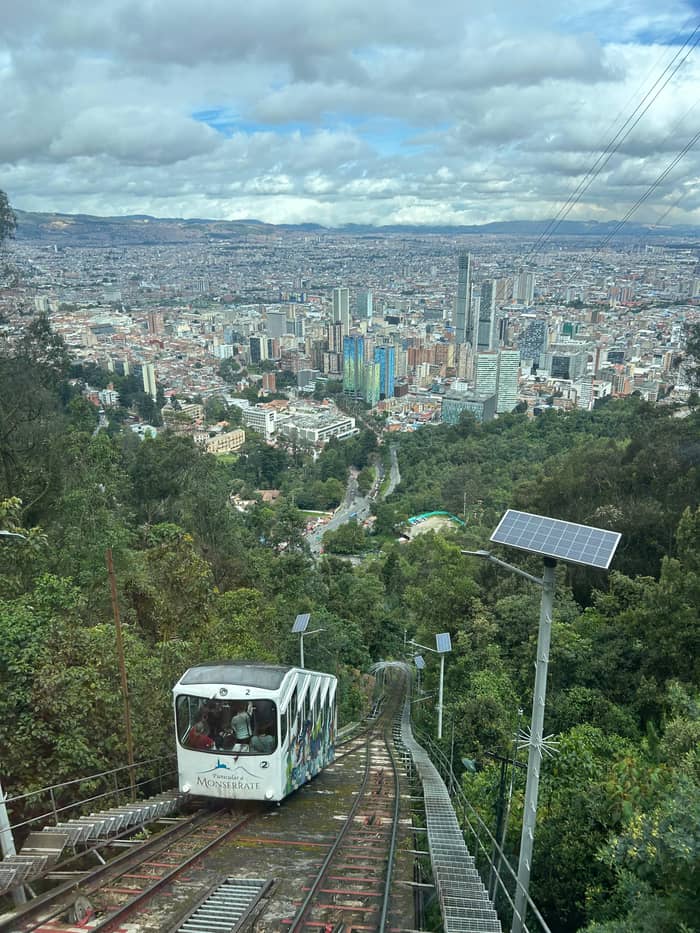
Namesake of the hill
Replica of the Barcelona image
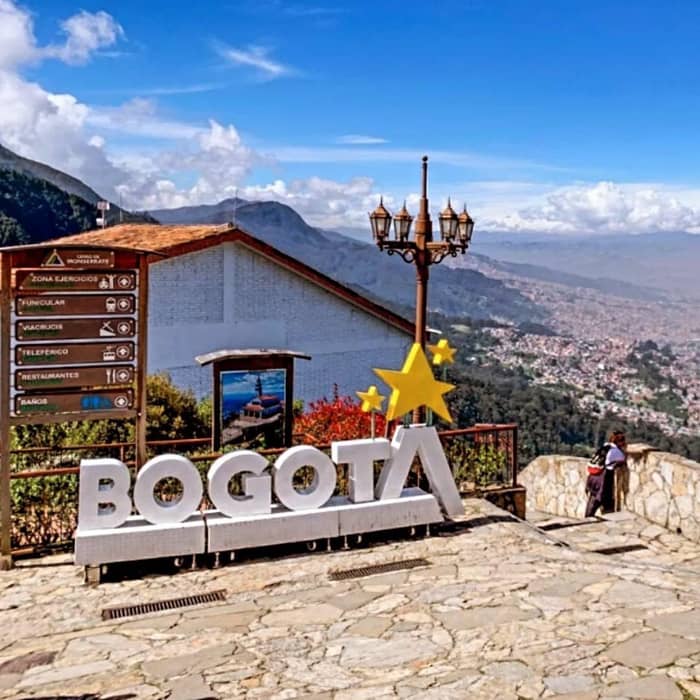
Walking devotion
Images brought from Italy
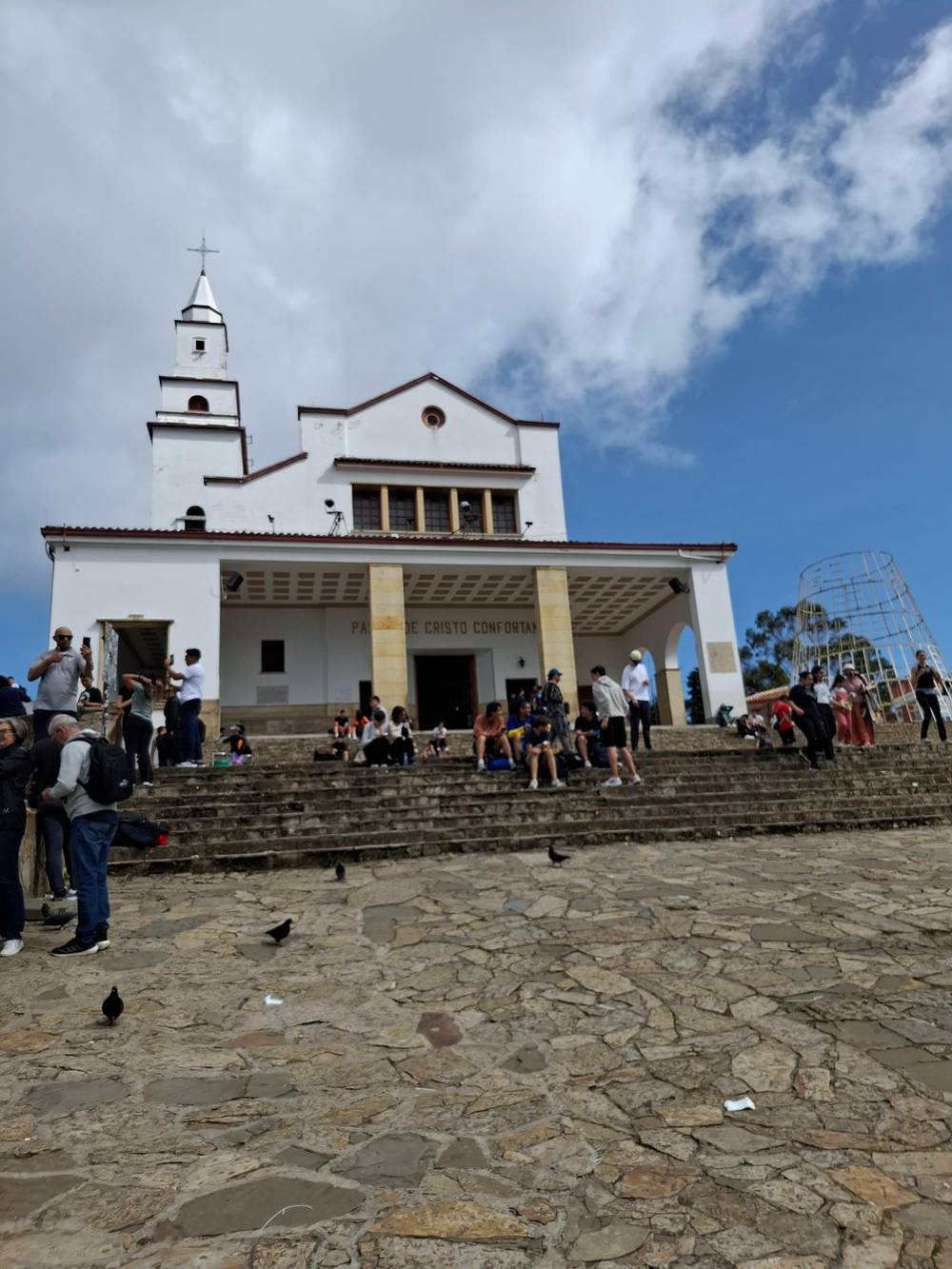
The building has a long story of its own. The sanctuary site says a new sanctuary was completed in 1925 to replace the old shrine, which could no longer hold the growing number of pilgrims, and calls it among the most significant religious buildings in Bogota.5 Visit Bogota adds that the first hermitage, finished in 1657, was rebuilt after damage from the 1917 earthquake, and that the new church of 1925 was drawn by the architect Arturo Jaramillo Concha with Neo-Gothic lines.12,42 Anyone searching for the church of Monserrate in Bogota is looking at that building.
The look changed again in the middle of the century. According to the sanctuary, the church was renovated in 1949 and adopted a neocolonial style that remains today, and Pope Pius XII consecrated it as a minor basilica in recognition of its role as a center of devotion.6 The sanctuary describes the result as an elegant neocolonial church and a setting for moments of peace and reflection.1
Light is part of the architecture. Visit Bogota says the church began to be illuminated at night in 1938 for the celebration of the 400th anniversary of the city.41 From the plaza on the hill after dark, the lit building reads as a beacon above the capital, which gives travelers a reason to add a late visit to a morning visit when they have time to come back up the hill.
Through the centuries
City founding
Gonzalo Jimenez de Quesada founded the city in 1538, with Monserrate and Guadalupe counted among its guardians.10
First chapel
Pedro Solis de Valenzuela and others built a chapel to the Virgin of Montserrat in 1640.3
The carved Christ
In 1656 the priest Bernardino de Rojas commissioned the carving from Pedro Lugo de Albarracin.4
Earthquake years
The earthquakes of 1743 and 1745 devastated much of Bogota, and the chapel stood through them.14
The new sanctuary
The sanctuary of 1925 replaced the old shrine, which could not hold the growing crowds of pilgrims.5
Modern access
The funicular opened in 1929, the cable car in 1955 and the cobbled pilgrim path in 1980.15,16,17
The sanctuary publishes its basilica hours and its Eucharist schedule. The basilica is open daily except Tuesday, opening at 6:00 AM and closing at 7:00 PM, holidays included, and on Tuesday it opens at 12:00 PM and closes at 7:00 PM.8 The Sunday schedule is the fullest, with 6 services: the earliest at 6:30 AM, the latest at 2:30 PM and the rest spread through the morning, while Saturday and holidays have 5.7,23
The rest of the week is lighter. Friday has 3 services, with the earliest at 8:00 AM and the latest at 12:00 PM, and Monday, Wednesday and Thursday have 2, at 10:00 AM and 12:00 PM.24,25 Tuesday has 2 as well, at 12:00 PM and 2:00 PM, which fits the later opening of the basilica that day.26 The chart on this page lays the week out so you can see where a service falls before you plan the ride up.
Crowds follow the calendar. The sanctuary says weekends bring the highest turnout, and that Tuesdays, Wednesdays and Thursdays tend to be quieter when high season, school vacations and public holidays are not in play.31,30 Unlike many museums in Bogota, the hill stays open on Mondays, and the sanctuary warns that this can send more visitors up that day.43 A visitor who wants stillness over a service can choose a Wednesday or a Thursday.
Video
Life Theory Couple on YouTube · The clip loads only after you tap play.
The sanctuary is an ideal place for reflection, prayer, and peace of mind, especially on weekends and during special times like Holy Week and Christmas.
A pilgrimage church is a working shrine, and the visit goes better when you treat it as such. Visit Bogota calls the sanctuary a place suited to reflection, prayer and calm, particularly on weekends and at Holy Week and Christmas.34 Keep your voice low inside, step aside for people who are praying, and let the photographs wait until the moment has passed. These are habits of courtesy rather than posted rules.
The ground around the church asks for care. The sanctuary site says the paths and trails are cobblestone and steep, and advises comfortable shoes, plus a light jacket for the breeze, an umbrella for showers and sunscreen when the sun is out.38 It also advises keeping children close in areas with stairs or steep slopes and folding strollers before boarding the cable car or the funicular.40 The paths on the hill are uneven and inclined, a point to weigh for anyone with reduced mobility.39
After the church there is the summit to explore. ProColombia describes gardens with floral arrangements and the Pozo de los Deseos, a wishing well where visitors toss a coin, as well as a large square behind the sanctuary with handicrafts and souvenirs and restaurants serving dishes such as ajiaco and caldo de costilla.27,28 A souvenir machine presses a coin bearing an image of the Sanctuary, a small memento of the climb.29
Visit Bogota suggests 2 to 3 hours at Monserrate, which is enough for the church, the gardens, the square and the view without hurrying.44 The institute's day for a first visit opens on the mountain with the cable car or the funicular before heading down to La Candelaria, so the sanctuary suits the start of a day rather than the end.45,46 The sanctuary site, for its part, points to the hours after 3 PM for a calmer sunset visit.47
The hill stays in view on our private city tour without being compulsory: its itinerary treats Monserrate as an optional visit of 1.5 hours that costs extra, alongside museum and old-center stops, so it is worth deciding ahead of time whether that extra hour and a half belongs in your day. Booking starts from $70, with free cancellation up to 24 hours before.
Whichever route you choose, give the sanctuary a quiet moment of its own. The church is the reason the hill exists, and a few minutes inside with the lamps and the carved figure give the panorama outside its meaning. If you reach the top by cable car, your visit also joins a long line of pilgrims who have climbed to the same church for centuries by the path below.
FAQ
The sanctuary says the priest Bernardino de Rojas commissioned it from Pedro Lugo de Albarracin in 1656 and that it became the focus of devotion.4
The sanctuary lists 6 Eucharist services on Sunday, running from 6:30 AM to 2:30 PM.7
Visit Bogota says the lighting began in 1938 for the celebration of the city's 400th anniversary.41
Sources
Planning Monserrate and the old centre in one day? Ask a real person here.